Absolute decision rights
The Triple-Lock gateway
Legal, Risk, and Engineering must reach consensus in under 50ms, or the transaction is blocked. No single stakeholder can silently authorize execution against your Anchor Prose.

Mechanical constraints
BiDigest ships enforcement primitives: intercept before execution, evidence under audit, and sovereignty over which policy layer applies. Below are the three mechanical constraints that produce the triple-lock outcome — not passive "AI visibility."
Why this matters now
The question is shifting from "Do we have an AI policy?" to "Can we afford the gap between what we approved earlier and what we are about to commit?" Three pressures often land on the same systems and budgets—so routing around execution architecture gets expensive.
Liability & operational risk
Agentic and automated workflows raise expectations for attribution and replay after a bad outcome—not a slide deck alone.
Regulatory & audit clocks
Frameworks increasingly expect demonstrable controls and traceable decisions for material systems—scope varies by tier and jurisdiction.
Cryptographic transition
PQC roadmaps and long-lived evidence raise the cost of informal audit trails and mutable narratives.
Structural risk: time-of-check to time-of-use—approving intent at t1 and executing against the world at t4 without re-binding at the commit boundary is how stale authority becomes committed reality.
From
To
Enterprise proof on governed paths
Verify before execution
Authorization is checked before CRM, payments, or ERP change—not only explained in a dashboard after the fact.
Replayable receipts
Each governed path can log receipt_id and sealed evidence you can re-run—not trust-me console narratives alone.
Fail-closed enforcement
REJECTED and REVIEW_REQUIRED stop blind commits; human review gates risky AI-triggered operational actions.
Mechanical constraints are not opaque “AI safety.” The Identity Fidelity Quotient (IFQ) combines Anchor (A), Schema (S), Citation integrity (C), and Fidelity (F) at the commit boundary — so admissibility is a deterministic outcome, not a vibe check.
Patent pending — US Prov. App. No. 63/XXXXX
Absolute decision rights
Legal, Risk, and Engineering must reach consensus in under 50ms, or the transaction is blocked. No single stakeholder can silently authorize execution against your Anchor Prose.
Procurement-grade evidence
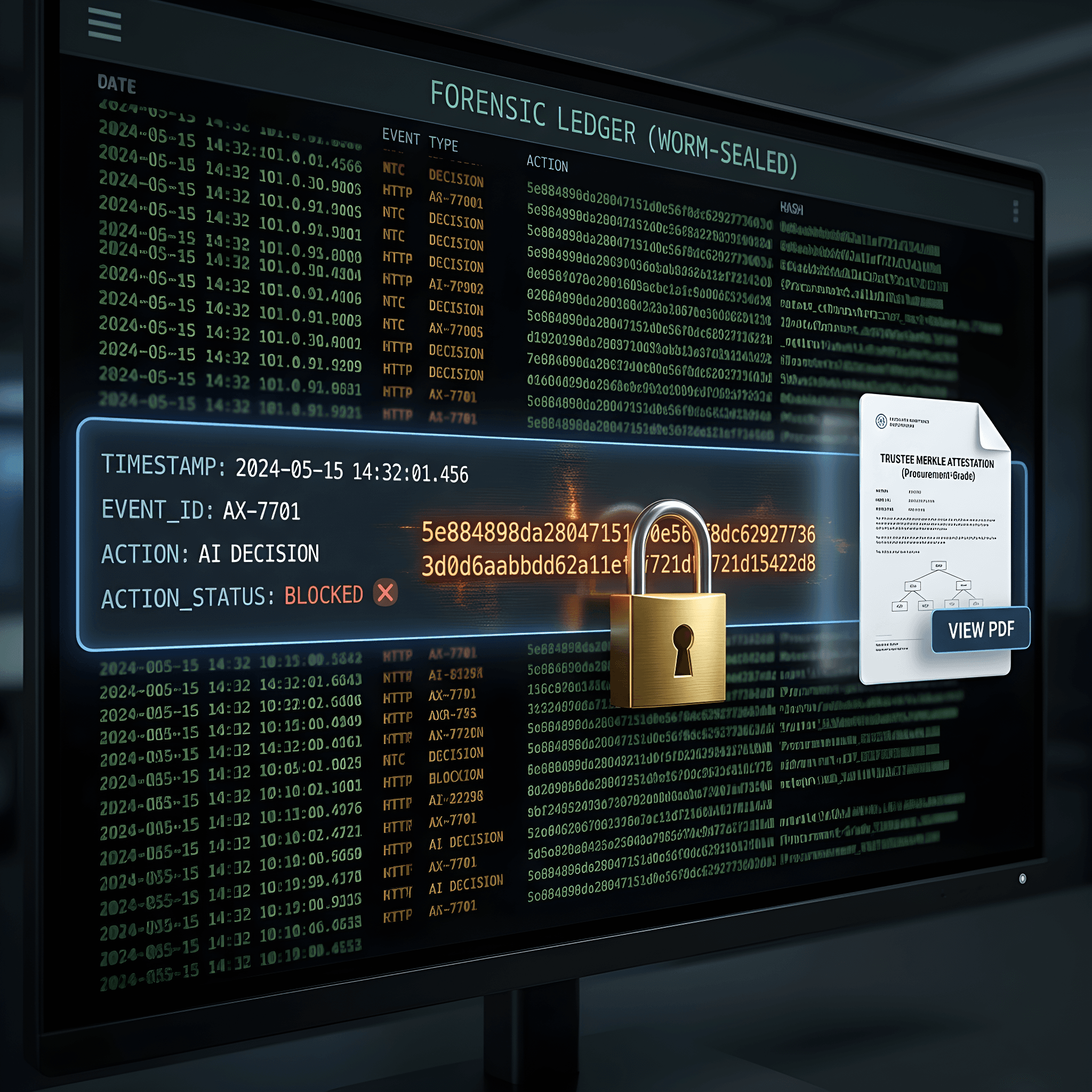
Every AI decision that passes the boundary generates a cryptographically immutable receipt. You do not merely log actions — you seal them for federal auditors and internal controls.
The splinternet solution
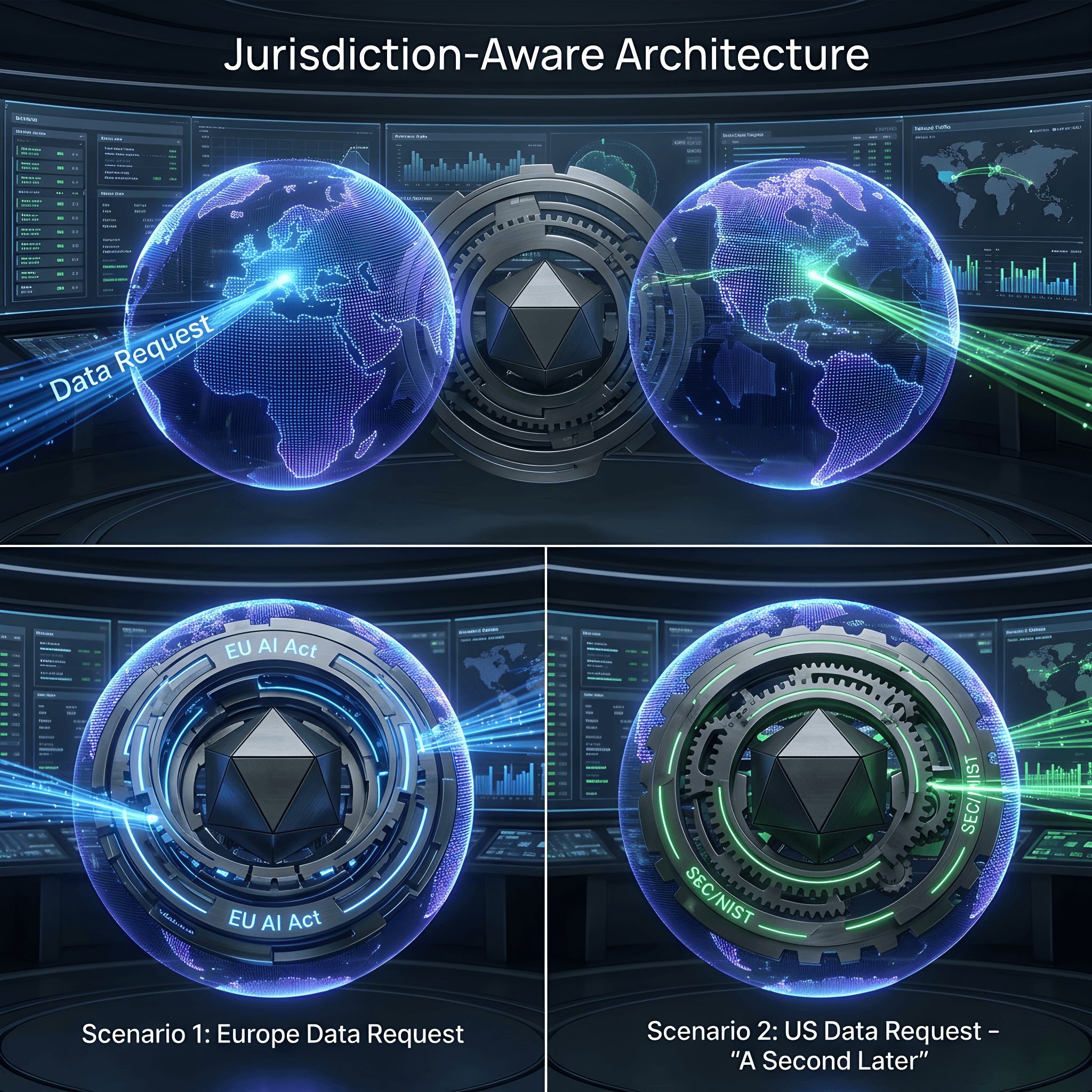
Your AI follows the EU AI Act in Frankfurt and NIST-aligned controls in Virginia using the same deterministic engine — policy routing and knowledge boundaries, not duplicate stacks.
Sanitized sample of a Merkle attestation-style receipt (HTML). Production exports may attach to your forensic workflow and auditor packages.