Execution boundary
Beyond Observability: Deterministic Enforcement for Sovereign Risk.
Evidence-custodian posture: move from monitoring-only views to bind-time enforcement where configured. Identity Fidelity and the Sovereign Tier target an execution boundary for operator notification windows and audit-oriented citation discipline—not legal advice, not a filing claim, and not another observability pane alone.
On governed paths, BiDigest evaluates admissibility at bind time using our patent-pending Stateful Trajectory approach—so execution proceeds only when the trajectory matches current authority and policy. Typical verify latency for the sovereign priority path is shown above; see the boundary latency report for methodology and samples.
The four pillars of IFQ
The engine scores Identity Fidelity Quotient (IFQ) so every transaction is admissible or explicitly denied. Sovereign tier combines anchor, structure, citation integrity, and verbatim fidelity — in production, A/S/C are blended with F as a multiplicative gate on the combined score (see verify API and handbook).
Anchor (A)
Patent pendingGround truth tether
Direct cryptographic tether to Ground Truth: regulatory identity and anchored prose are bound before any output is admissible.
Structure (S)
Patent pendingZero schema drift
Zero-tolerance for schema drift at the gateway. Malformed agent payloads fail closed — they never reach downstream systems.
Citation integrity (C)
Patent pendingShadow citations
Multiplicative gate that severs unverified “shadow citations” (e.g. non–government summaries masquerading as authority). If citations are not on the tenant allow-list, the transaction is not admissible.
Fidelity (F)
Patent pendingVerbatim magnitudes
Verbatim matching for regulatory magnitudes and clauses — e.g. euro amounts like €20.000.000,00 and nested EU article syntax. Decimal or clause drift is treated as a hard failure at the boundary.
Combined A · S · C · F IFQ calculus: Patent pending — see handbook Chapter 2.
Harvesting the Drift: Your Recursive Compliance Moat
AI agents are not static; they drift. Our Weekly Drift Analytics dashboard surfaces the "Invisibility Gap" — the 0.85–0.95 IFQ warning band where subtle hallucinations begin. We do not stop at reporting near-misses: operators harvest patterns on a seven-day loop to harden the sovereign dictionary.
One-click hardening. Found a new way the model misinterprets Art. 32? One click opens a structured request to add the pattern to the server-side dictionary — shrinking repeat drift before it becomes a breach narrative.
Global readiness: Singapore (MAS) and UK
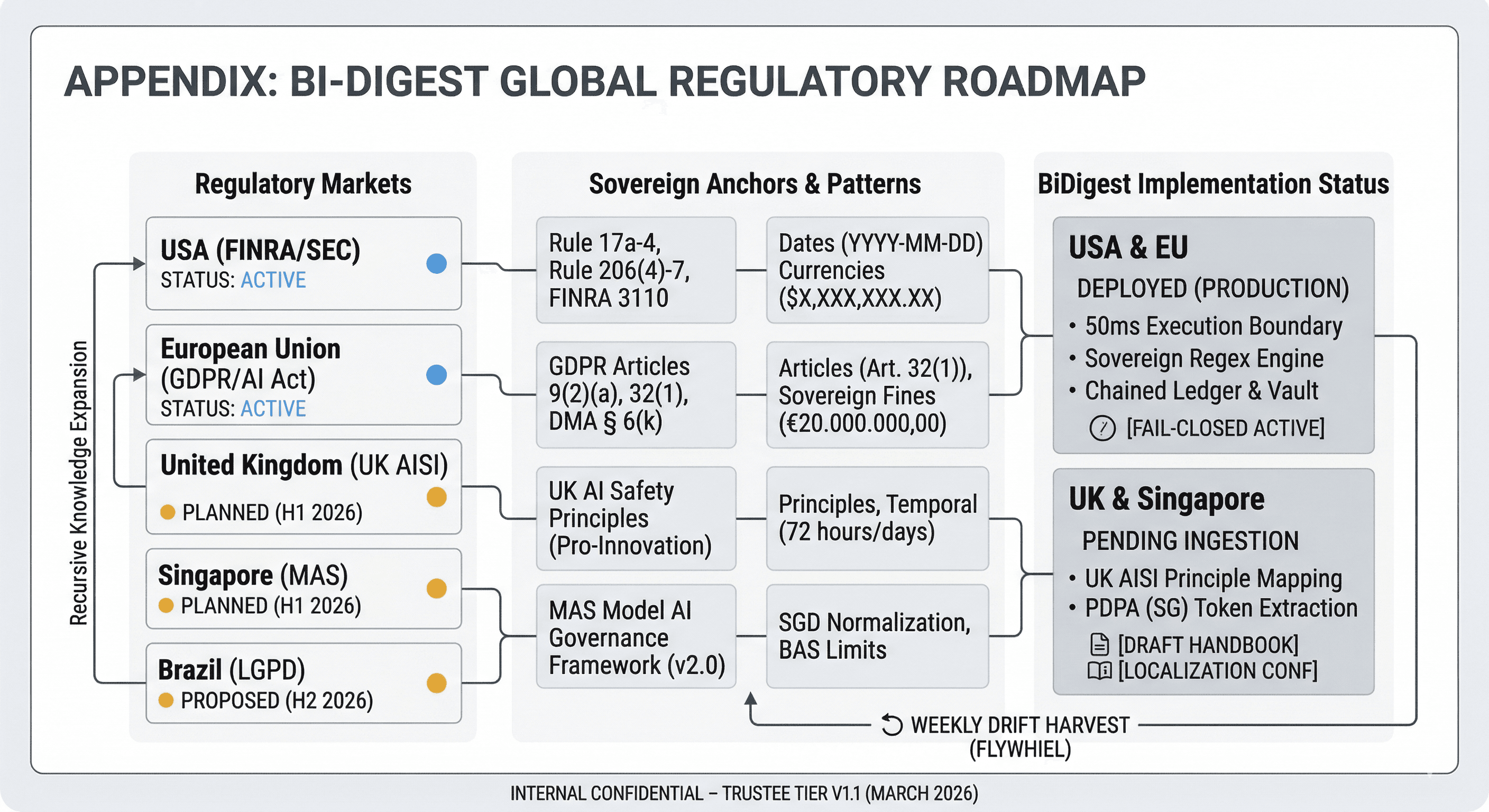
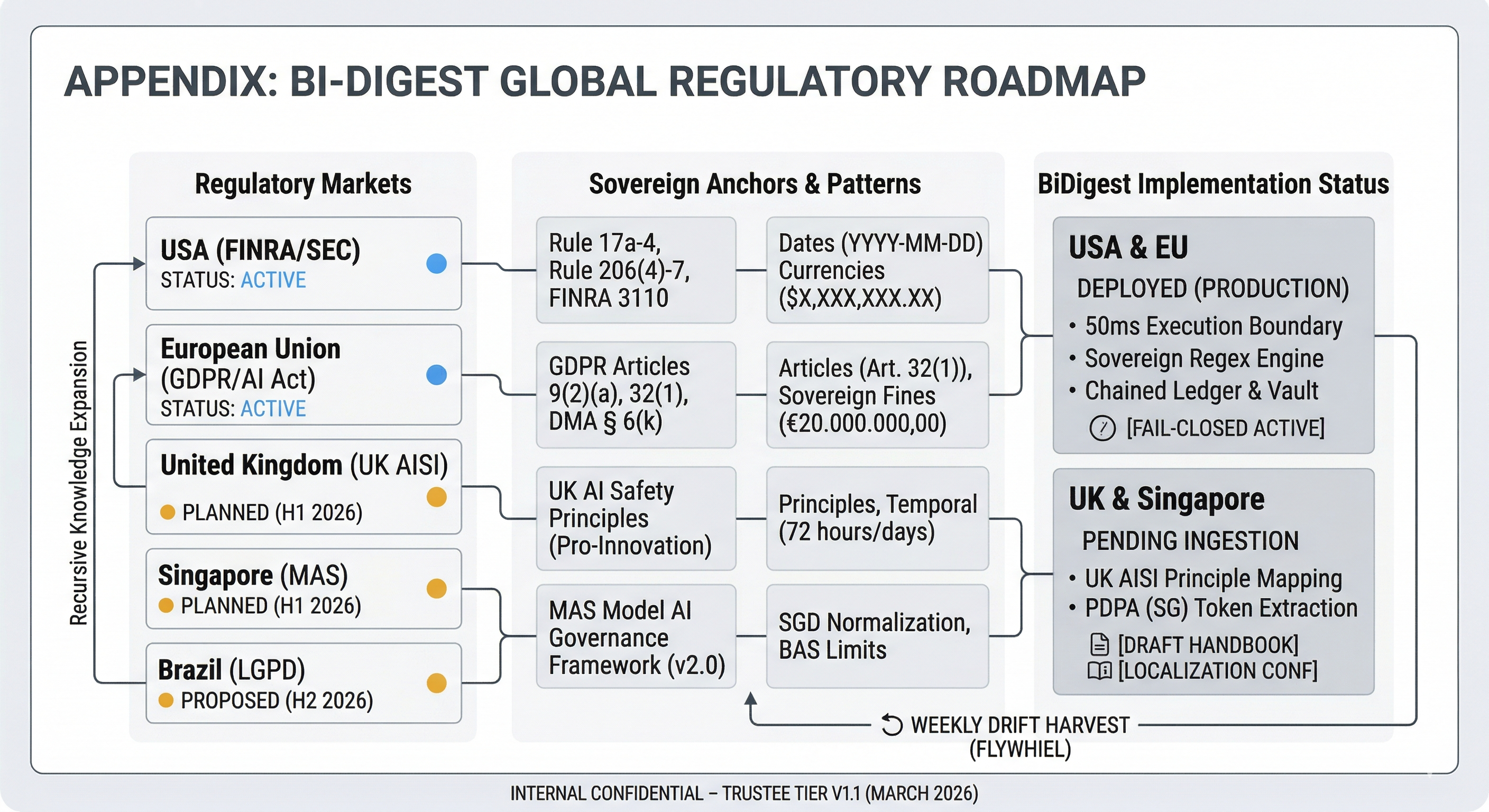
Deploy globally with local precision. BiDigest supports Singapore MAS Model AI Governance Framework (v2.0) and PDPA-style section anchors alongside EU and US overlays — so national regimes are first-class inputs to the boundary, not afterthoughts.
Canonical normalization. Whether it is S$17M, SGD 17m, or $S 17 million, the engine normalizes to a canonical magnitude so Singaporean operations meet the same deterministic standards as EU and US branches.
The Trustee Tier Handbook: Your Technical Prospectus for AI Governance
Moving past generic "AI safety" language: the handbook is the technical specification for stateful trajectories, authority decay (λ), and the re-bonding handshake — the same framing institutional audit teams use when signing off on governed agent stacks.
Launch mode (operations)
Production defaults are set in the host environment (e.g. Vercel). For Trustee / Sovereign rollouts, operators typically set ADMISSIBILITY_TIER_DEFAULT=SOVEREIGN so new anchors default to the strict profile (per-request compliance_tier still overrides). Documented reference: docs/internal/ADMISSIBILITY_LAUNCH_MODE_ENV.md in the repo (latency SLA knobs, IFQ floors, session TTL). IFQ blend weights and sovereign hard-token extraction run server-side only — clients receive scores and diagnostics from the verify API, not the full engine.
- NODE_ENV=production — standard Next.js production build on Vercel
- ADMISSIBILITY_TIER_DEFAULT — optional; set to SOVEREIGN when you want the global default tier label strict at provision time
- Redis / Upstash — stateful trajectory chain and drift bucket telemetry; clear demo keys such as sess_9921_alpha before first production tenants if you reused them in staging
Sovereign diagnostic (illustrative lock)
When IFQ drops below policy, the trajectory locks with explicit A · S · C · F (Patent pending) pillars (Sovereign includes citation integrity C) — not a generic 403. Below: Art. 32 verbatim drift style messaging with hard-token diff.
TRAJECTORY_LOCKED
Art. 32 verbatim drift detected
Authority decay threshold reached (0.18 < 0.20). Execution pauses until a human re-anchors to Ground Truth.
Anchor
PASS
A
Structure
VALID
S
Sources
—
C
Fidelity
0.84
F
IFQ: 0.84 (A·S·F product) | Latency: 24ms
Breach detected: hard token inconsistency
- Anchor:
€2.500.000,00 - Payload:
€2.500,00 - Variance: Magnitude shift ≈ −99.9% vs anchored supervisory fine
Forensic summary
Does the boundary slow agents?- Cumulative Drift
- 0.82 / 0.80
- Transaction Index
- Step 14
- Session ID
- sess_9921_alpha
- Last Receipt Hash
- sha256:8f92a1b…
Resets authority TTL to 1.0 and clears cumulative drift. A new machine handshake will be issued.
View Full Trajectory LedgerRequest Trustee access
Enterprise architects and CCOs: start with vault intake. Reference Sovereign / Trustee Tier in your message.
Appendix: Global Regulatory Roadmap
Investor- and audit-facing view of how the execution boundary extends across jurisdictions (EU, US, Singapore, UK). Same asset ships in the Trustee Tier handbook.